
PLC Programming & Automation
An existing industrial machine required its control sequence to be reviewed, recreated and updated using a Schneider Electric Zelio programmable relay. The project involved understanding the required machine behaviour, developing the control logic, implementing timers and interlocks, simulating the complete operating sequence and preparing the system for commissioning.
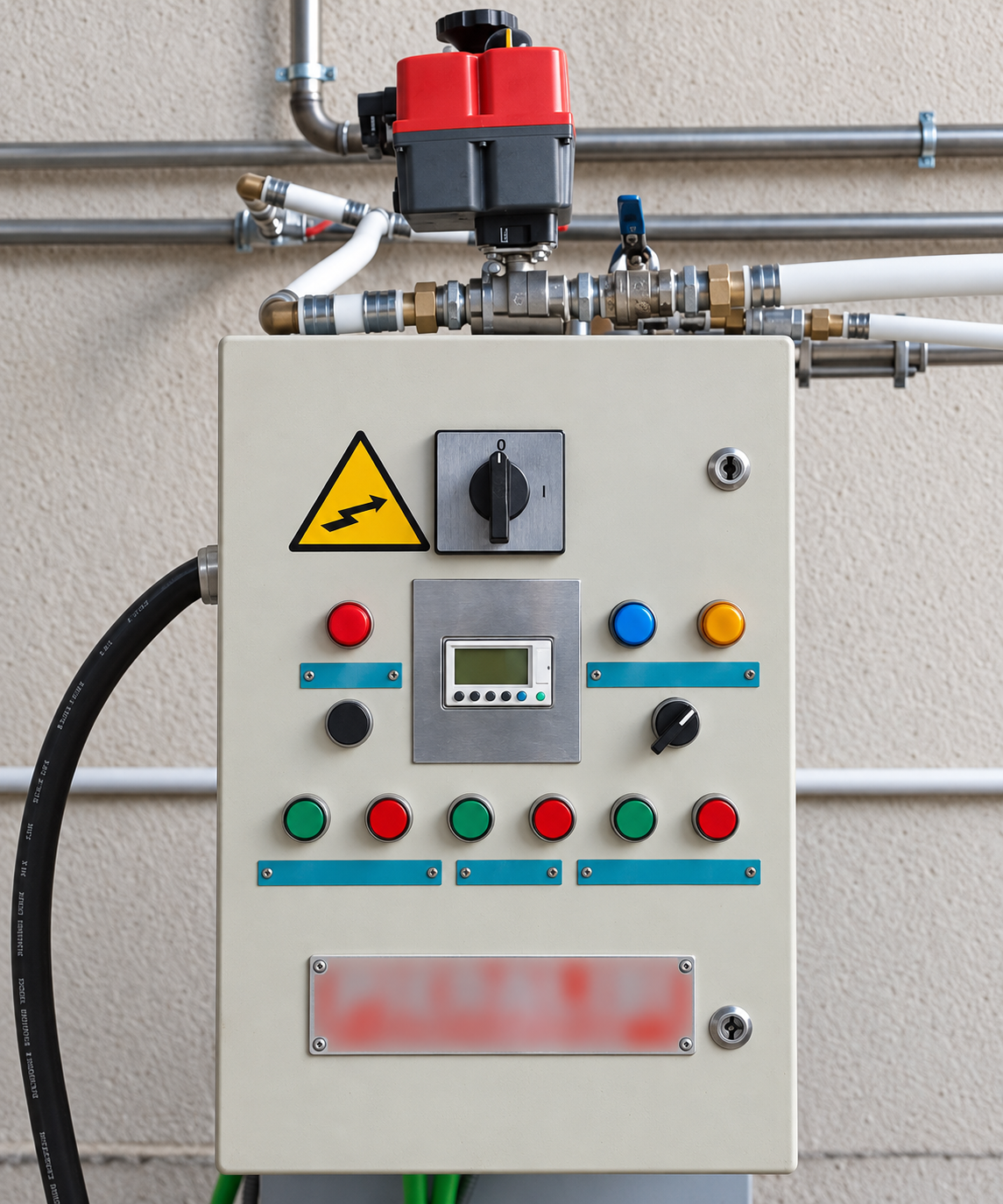
Existing machine control panel containing the programmable controller and operator controls
The Challenge
The main challenge was not simply replacing or reprogramming a controller. The required machine behaviour first had to be reconstructed from the available documentation and translated into a clear, repeatable control sequence.
The machine uses a combination of timed operations, digital inputs, relay outputs and internal logic to manage the automatic discharge cycle. The sequence also includes an operator-triggered anticipated discharge, which must behave differently from the normal automatic cycle.
The control therefore had to be rebuilt carefully so that each stage occurred in the correct order, with the correct timing, while ensuring that the system returned to a defined state after each cycle.
Understanding the Existing Control Sequence
The first stage was to identify the relationship between the machine inputs, outputs and timing functions.
The original control philosophy was broken down into individual operating states: production, initiation of discharge, water injection, drum opening, drum closing, filling and return to production.
This made it possible to understand not only which output should operate, but also what condition should start each stage, how long it should remain active and what should happen afterwards.
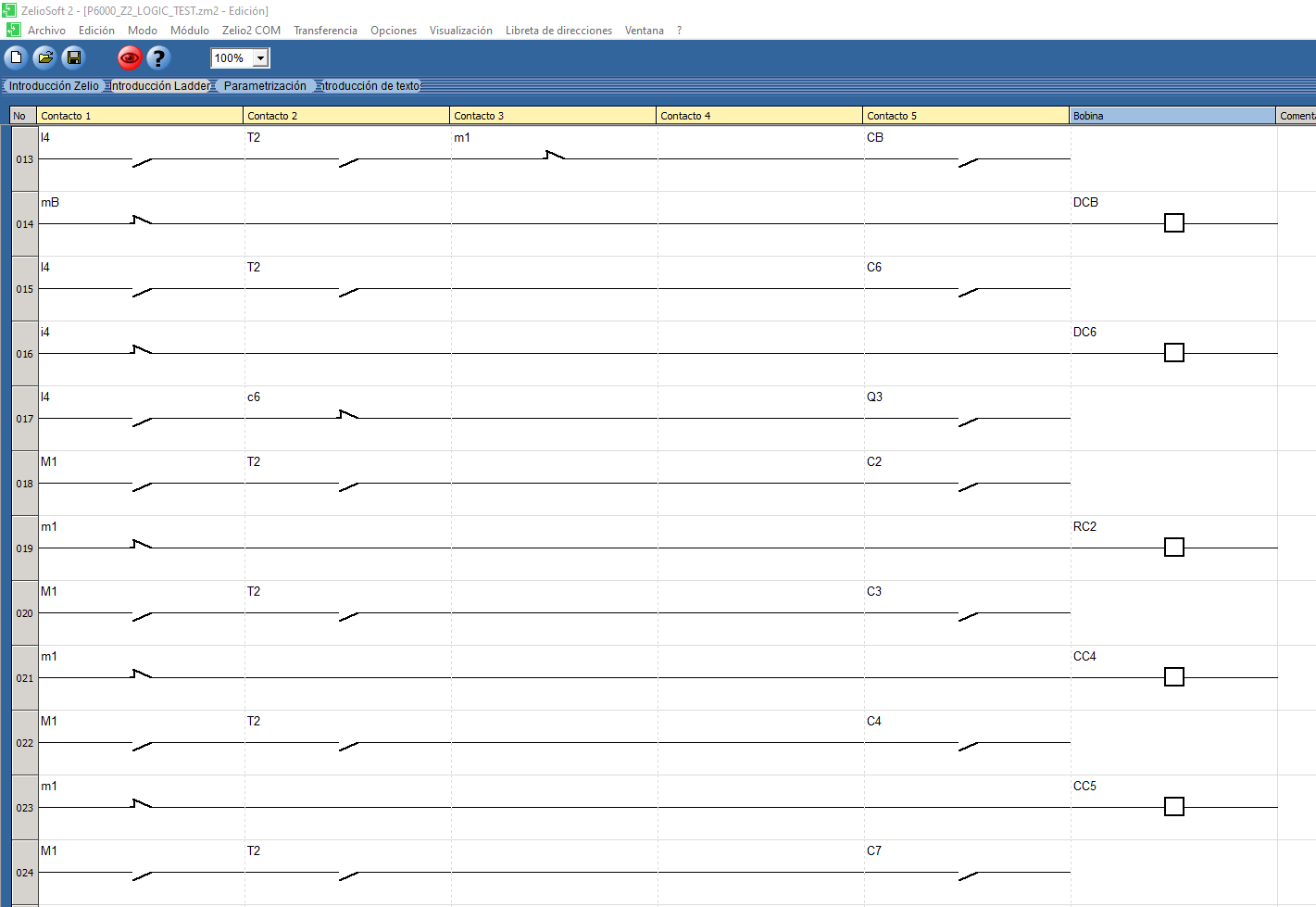
Reconstructed control sequence implemented in Schneider Electric Zelio Soft 2 using Ladder logic
Rebuilding the Control Logic
The program was rebuilt in Ladder logic for a Schneider Electric Zelio Logic SR2B121B.
Internal memories were used to represent operating states and conditions, while timers reproduced the main process intervals. Interlocks were then applied so that each output could only operate under the correct conditions.
Particular attention was given to the end of the discharge sequence. After a normal automatic discharge, the system must return to production automatically. After an anticipated discharge initiated by the operator, the feed pump must remain stopped until the operator explicitly rearms the system.
Production → Discharge → Emptying → Drum opening/closing → Filling → Return to production
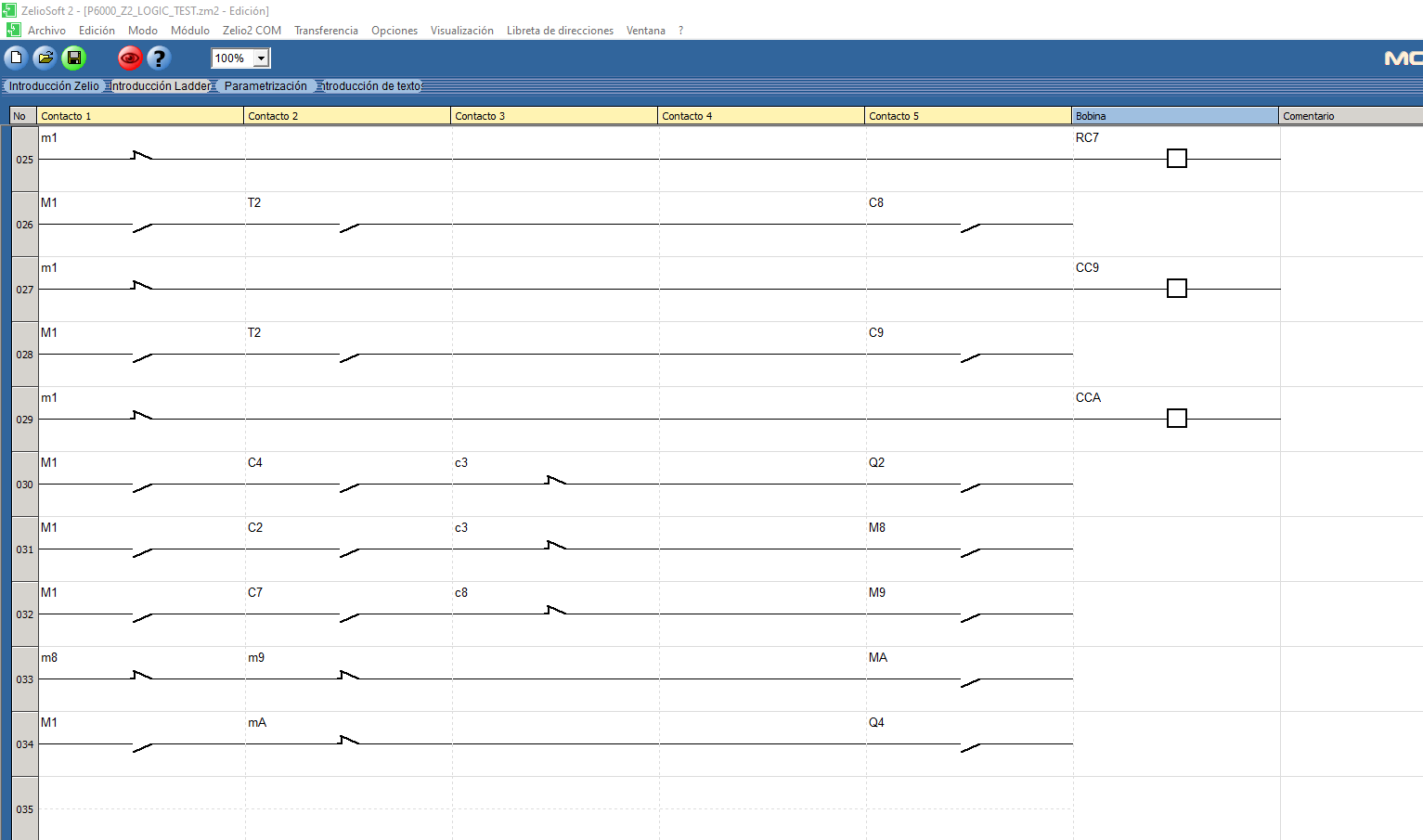
Additional Ladder logic implementing the timed sequence, internal states and output control
Timer Configuration and Testability
The machine sequence depends heavily on timing, so the original process values were reproduced using Zelio timers.
The main discharge interval, T8, is normally configured to 1 hour. During simulation, this interval can temporarily be reduced so that complete automatic cycles can be observed without waiting for the full production period.
This approach allowed repeated functional testing while preserving the correct production settings for the final program.
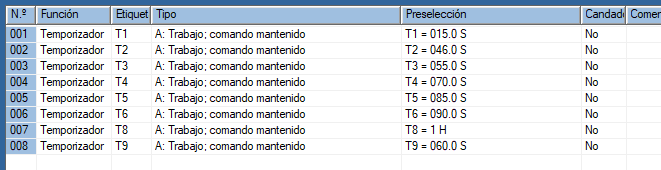
Final timer configuration used to reproduce the documented machine sequence
Simulation and Verification
Before transferring the program to the physical controller, the control logic was exercised in Zelio Soft 2 simulation.
Digital inputs were changed manually to reproduce machine conditions while outputs, timers and internal memories were monitored throughout the sequence.
Testing included the initial state, automatic start, feed-pump confirmation, automatic discharge, anticipated discharge and operator rearm. Shortened values were used for T8 during simulation, then restored before the final program was saved.
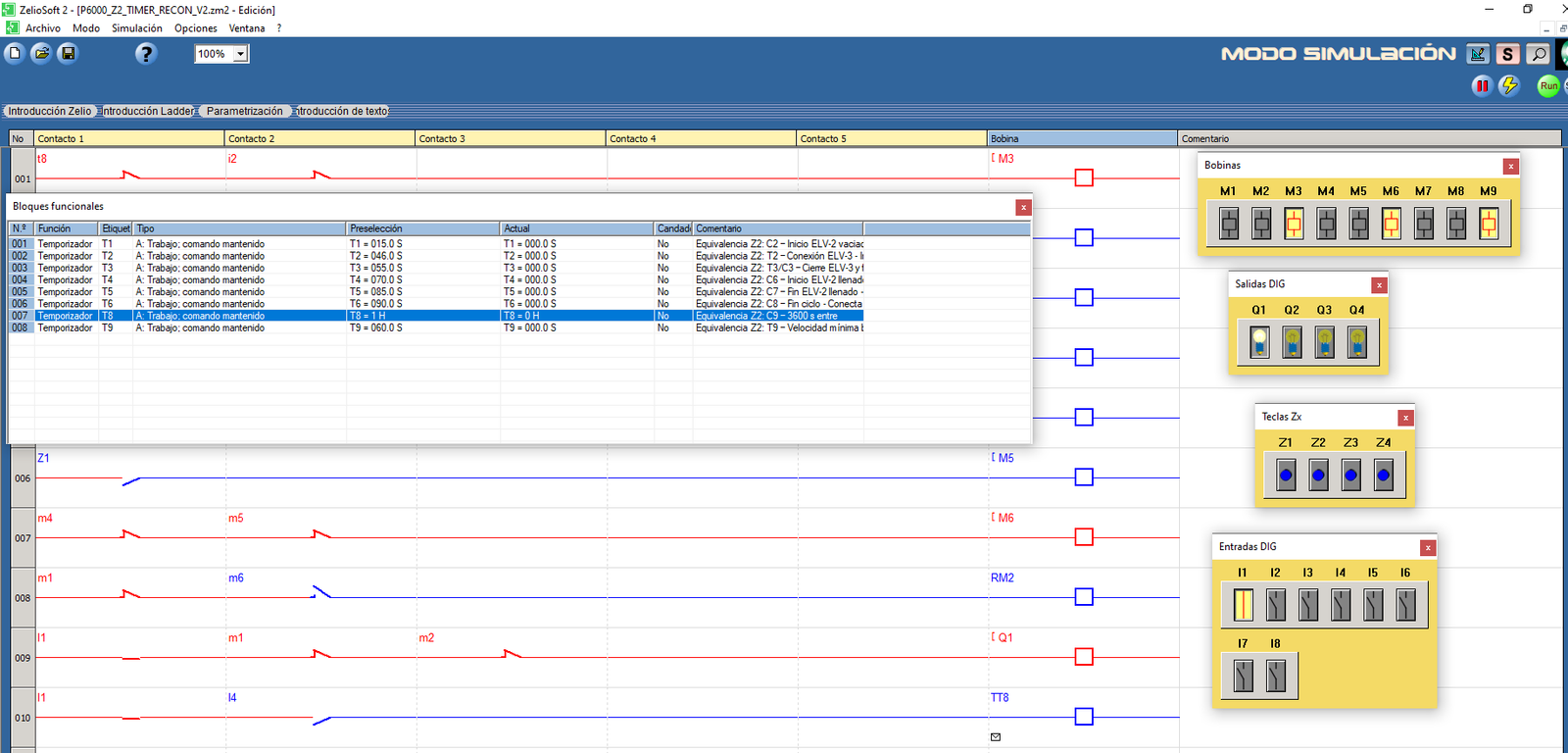
Zelio Soft simulation environment with inputs, outputs and internal memories visible during testing
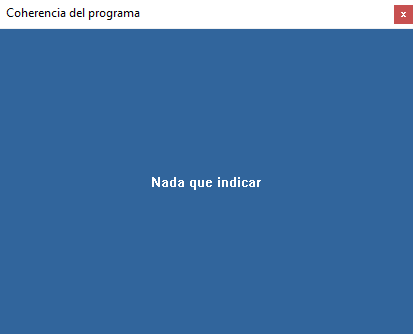
Final Zelio Soft coherence check completed with no reported program errors
Implementation on the Physical Controller
After software verification, the final program was prepared for transfer to the physical SR2B121B controller.
The implementation process included confirming the correct controller reference, communication settings and program file before transferring the software to the module.
The final commissioning procedure also required checking the physical relationship between the Zelio outputs and the connected pump, solenoid valves and variable-speed drive before authorising automatic operation.
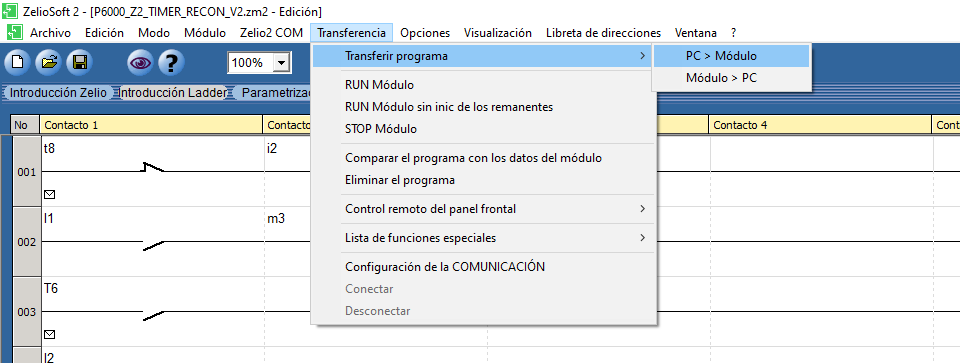
Transfer of the verified program from Zelio Soft 2 to the physical controller
Documentation and Handover
The project did not finish with the program itself. Supporting engineering documentation was prepared so that the reconstructed logic, operating sequence, test procedure and controller configuration could be understood and maintained in the future.
Separate step-by-step instructions were also prepared for reading the existing program from a controller and transferring the new program to the module.
Engineering deliverables
– Reconstructed Zelio Ladder program
– Timer and interlock configuration
– Functional simulation procedure
– Automatic and anticipated-discharge verification
– Controller loading instructions
– Backup/readback procedure
– Engineering report and commissioning checks
Outcome
The completed work produced a documented and testable reconstruction of the machine control sequence for the Zelio SR2B121B.
The software reproduced the principal timing and I/O behaviour described by the available machine documentation, passed the Zelio Soft coherence check and provided a structured procedure for simulation and commissioning.
The result was not only a reconstructed control program, but a solution that could be understood, tested and maintained rather than remaining as undocumented legacy logic.
Need support with an existing control system?
ElectronPath supports industrial control modifications, programmable-relay and PLC development, electronics troubleshooting and engineering review for existing equipment and new developments.
Discuss Your Project →